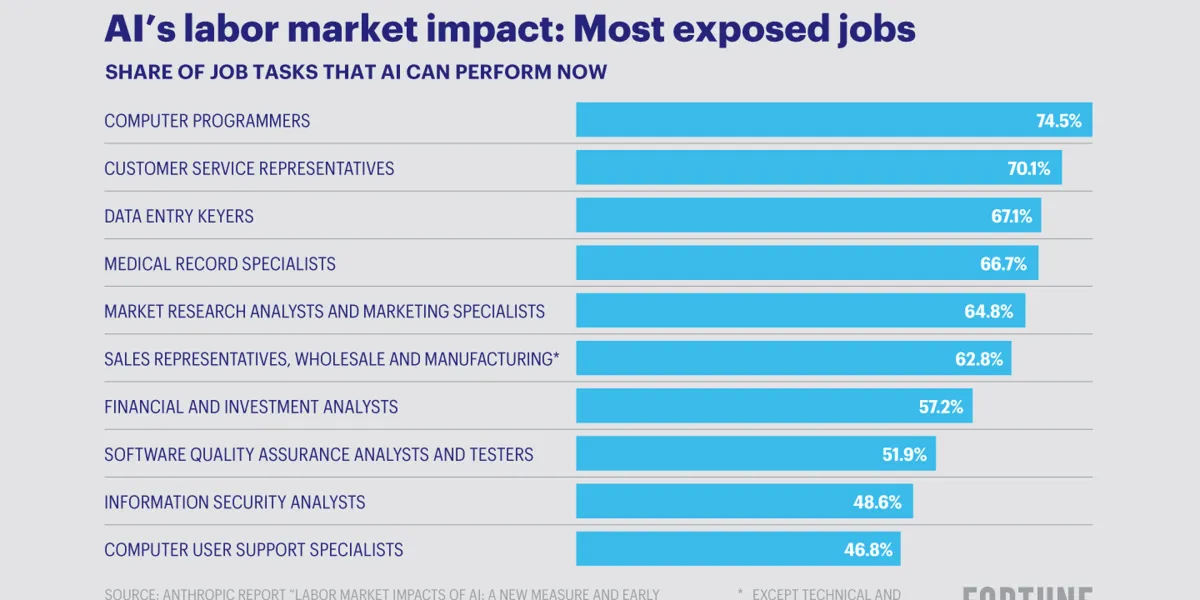
The landscape of intelligence and labor is undergoing a dramatic transformation, driven by the rapid advancements in generative AI. As corporations and professionals closely monitor these developments, anxieties have emerged regarding the future of white-collar jobs. A recent report from Anthropic has encapsulated these concerns, revealing high levels of exposure to AI across various professions. This discussion is not just academic; it has serious implications for the economy, job creation, and personal finance strategies.
Understanding the Current Economic Context
In early 2026, the intersection of technology and employment is at a pivotal moment. The ongoing evolution of artificial intelligence is reshaping industries such as finance, marketing, and management, leading many to speculate about a potential **white-collar recession**. The Anthropic report sheds light on the observed and theoretical exposure of various occupations to AI, igniting concerns among professionals and economists alike. Job roles previously deemed stable are now scrutinized, particularly as **investment strategies** must adapt to these changing dynamics.
Insights from the Anthropic Report
The Anthropic report, titled “Labor market impacts of AI: A new measure and early evidence,” is based on real-world usage of its Claude large-language model. This groundbreaking research categorizes professions based on their “observed exposure” and “theoretical exposure” to AI. In essence, this means evaluating the percentage of tasks within a job that AI systems can fulfill currently versus what they could potentially handle in the future.
What Does Theoretical vs. Observed Exposure Mean?
The distinction between theoretical and observed exposure is crucial. Theoretical exposure refers to the potential capabilities of AI to automate certain tasks based on existing technology, while observed exposure gauges actual implementation in the workplace. For example, fields such as computer programming and financial management have high theoretical exposure, suggesting a significant capacity for AI to take over these roles, raising alarms about job displacement.
The Economic Implications of Job Displacement
A high theoretical exposure in secure professions indicates a looming risk of job loss, especially in industries that rely heavily on cognitive tasks. These changes could lead to substantial upheavals in the job market, resulting in increased unemployment rates, which might, in turn, affect consumer spending and economic growth.
Real-World Examples of AI Exposure
The report points to sectors like coding, where theoretical exposure reaches around 94%, yet actual adoption lags at approximately 30%. This presents a stark contrast reflecting how the integration of AI varies significantly across professions. Other professions, like microbiologists or real estate managers, offer an illustration of how AI could enhance existing skills rather than replace them outright. For instance, while AI might handle data analysis, the essential roles that require human interaction remain irreplaceable.
Which Industries Experience the Most Change?
- Technology: High levels of disruption anticipated, particularly in programming roles.
- Finance: **Financial management** could see enhanced efficiencies through AI, yet human oversight remains critical.
- Real Estate: Automation streamlining administrative tasks while preserving interpersonal negotiation roles.
- Health Sciences: Professions emphasizing human expertise, like microbiology, may benefit through AI alongside traditional methods.
Macro and Microeconomic Effects
The macroeconomic impacts stemming from increased AI integration are multifaceted. As automation permeates various sectors, the resultant productivity gains could lead to shifts in **inflation rates** and **interest rates**. Consequently, understanding these dynamics will be crucial for both individuals and corporations navigating this transition.
Impact on Inflation and Interest Rates
As businesses leverage AI to improve productivity, there is potential for **disinflationary** pressures to emerge. With reduced labor costs and increased efficiency, firms could lower prices, influencing the overall inflation rate. However, if unemployment rises significantly due to displacement, consumer spending may decline, complicating the relationship between productivity and inflation.
Employment and Stock Market Dynamics
Inflation and interest rates directly affect **stock market** performance. A rocky transition caused by high unemployment might lead to reduced consumer confidence, impacting corporate earnings and stock valuations. The **stock market today** reflects these uncertainties, as investors recalibrate their expectations based on anticipated changes due to generative AI.
Opportunities and Risks in the Age of AI
The introduction of AI into various sectors presents both opportunities and risks. On the one hand, individuals and companies that adapt swiftly to **AI technology** gain a competitive edge. On the other hand, failure to adapt could result in significant setbacks, particularly for those in fields experiencing high displacement rates.
Best Investments Moving Forward
Investors should focus on sectors showing resilient demand amid AI integration. Companies that prioritize **financial planning** and commit to employee retraining programs are likely to thrive. Key areas to consider include:
- Tech Stocks: Companies advancing AI technologies.
- Healthcare: Institutions that combine AI capabilities with indispensable human expertise.
- Training and Education: Organizations offering retraining programs for displaced workers.
Strategies for Risk Management
To mitigate the risks associated with this technological transition, individuals and corporations should consider the following strategies:
- Continual education and skill development in fields that complement AI.
- Adopting an adaptable **investment strategy** focusing on diversified portfolios.
- Monitoring economic indicators to anticipate market shifts.
Future Perspectives
The developments emerging from this AI evolution challenge traditional notions of work. As we advance into a more automated future, the effects on **personal finance**, budgeting, and retirement planning become inevitable. For example, higher-frequency trading could dominate stock markets, influencing **credit card rates** and **mortgage rates**.
Preparing for an Automated Future
For those entering the workforce today, acquiring adaptable skills and **transferable expertise** remains paramount. Academic programs that emphasize critical thinking, creativity, and emotional intelligence will likely be better positioned for future job markets. Thus, embracing AI as an ally rather than a threat may define the next generation of professionals.
Concluding Thoughts
This ongoing shift towards an AI-driven labor market prompts profound discussions about labor, technology, and economics. As we stand on the brink of potentially significant job displacement and market evolution, understanding the benefits, risks, and strategies related to AI exposure is crucial. Adopting an informed approach can empower professionals and investors to navigate these turbulent waters effectively, ensuring that the advantages of these technologies are harnessed for broader economic prosperity.